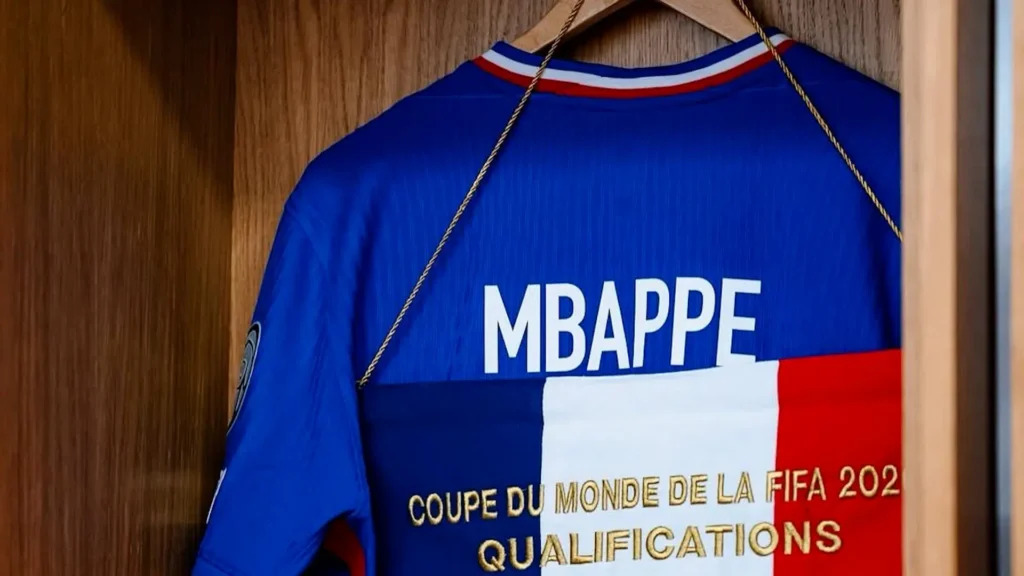
Kylian Mbappé’s 2025 gross income of approximately €110 million is the number that makes headlines. His take-home of approximately €69 million is the number that matters. The gap — €41 million, or 37.4% of the total — is not a tax burden that simply happened to him. It is the product of a deliberate income structuring strategy built across three jurisdictions, two corporate entities, and a signing bonus mechanism that distributes tax exposure across five fiscal years instead of one.
This article is the structural companion to our full 2025 earnings breakdown, which covers every income source and its net value in detail. Here, the focus is on the architecture itself: why the income is structured the way it is, and what it achieves.
The signing bonus mechanism: why €30M per year instead of €150M upfront
When Real Madrid structured Mbappé’s contract in 2024, the €150 million signing bonus was not paid as a lump sum. It was distributed as annual tranches of €30 million over five years. This is not a coincidence. A €150 million single payment in 2024 would have generated a Spanish income tax bill of approximately €70.5 million in that fiscal year alone — the full 47% IRPF rate on the entire sum. By spreading the payment across five years, each €30 million tranche is assessed separately. The annual tax on each tranche is approximately €14.1 million. The aggregate five-year tax cost is the same in absolute terms, but the cash flow implications are significantly more favourable: Mbappé retains more capital in the early years of the contract, which can be deployed into investments like Coalition Capital before the later tranches are taxed.
Spain’s IRPF and the Madrid Community deduction
Spain’s standard income tax reaches 47% on earnings above €300,000. Mbappé cannot use the Beckham Law flat rate of 24% — professional athletes have been excluded since 2015. He falls under the general IRPF progressive schedule as a Spanish tax resident.
What partially compensates is the Madrid Community’s Law 4/2024 — the regulation informally referred to as the Mbappe Law. It provides a 20% deduction on the regional IRPF component for qualifying investors who establish fiscal residency in Madrid and hold investments in the region for a minimum of six years. Madrid’s regional rate is approximately 9.5% of the applicable base; the 20% deduction reduces the combined effective rate from 47% to approximately 24.5% on eligible income. The full mechanics of this regime are detailed in our Mbappe Law analysis.
Endorsement income: why the foreign entity structure matters
A significant portion of Mbappé’s endorsement income is paid through foreign entities — Nike via a US corporate structure, EA Sports through its international licensing arm. Under Spain’s tax treaty framework, income from foreign sources received by a Spanish tax resident through non-Spanish corporate entities may be subject to the savings rate (approximately 26 to 28%) rather than the progressive employment income rate that applies to his salary and bonus.
The practical consequence is material. On his estimated €16 million annual Nike retainer, a 27% savings rate generates a tax bill of approximately €4.3 million, versus the €7.5 million that would apply under the standard IRPF rate. The difference — approximately €3.2 million per year on Nike alone — compounds across his five-year contract duration. Across the full endorsement portfolio (Nike, Hublot, Dior, Oakley, EA Sports), the savings rate advantage over standard IRPF is estimated at approximately €7 to €8 million per year.
The France national team layer
Mbappé’s France national team earnings — FFF stipends and FIFA match fees, estimated at approximately €2.5 million per year — are subject to French progressive income tax (IRPP) at approximately 45%, not Spanish IRPF, because they are paid through French entities. He has publicly committed to donating 100% of this income to charity through his Inspired by KM foundation, which means the tax treatment is largely moot from a personal wealth perspective — but it illustrates that his income structure spans multiple fiscal jurisdictions simultaneously.
The effective rate and what it means
Across all sources, Mbappé’s blended effective tax rate for 2025 is estimated at approximately 37.4% — significantly below the Spanish top marginal rate of 47%, and dramatically below the French effective rate he would have faced on the same income under the PSG system. The difference between his current effective rate and the 47% standard rate, applied to his total €110 million gross income, represents approximately €10.5 million in additional take-home per year compared to what a standard-rate Spanish resident would retain.
Over a five-year contract, that differential accumulates to approximately €52 million in additional net wealth generated by structure rather than by additional income. It is, in purely financial terms, one of the most consequential decisions of his career — and it required legal expertise, fiscal residency planning, and investment commitments that most athletes never undertake. For the complete 2025 earnings breakdown across every income source, see our €110M salary analysis.
— Victor Blanc | Mbappé Live
Deepen Your Intelligence
- The Mbappe Law: How Madrid Cut His Tax Rate to 24.5%
- Mbappé’s Real Madrid Contract: €150M Signing Bonus, 80% Image Rights
- Mbappé Won €110M in 2025 — and Kept €69M
- Mbappé’s Net Worth: He Earned Over €950M — So Why Does He Only Have €300M?
- Mbappé vs. PSG: The €703M Legal War

About the author
Victor Blanc
Football Business Correspondent at Mbappé Live. Covers contracts, sponsorships, investment strategy, and the financial architecture behind elite sport.