Salary, bonuses, sponsorships, tax optimization, litigation, investments. A forensic breakdown of how Kylian Mbappé built a €300M+ fortune before turning 27 — and the architecture designed to take it further.
The architecture: three revenue pillars, one strategic logic
Most elite footballers generate wealth through two channels: salary and endorsements. Mbappé operates a third — equity. The distinction matters. Salary and endorsements are linear; they stop when the contract does. Equity compounds. Understanding his financial empire means understanding how deliberately he has shifted from the first two toward the third.
His total gross income in 2025 sits around €110M, split roughly 60/40 between on-pitch and off-pitch sources. After Spain’s progressive IRPF — which reaches 47% above €300,000 — and the partial application of the Madrid Community’s 2024 tax deduction scheme, his net take-home is estimated at €69M. That number alone would make him one of the highest-earning individuals in France or Spain. But the salary is not where the long-term bet is placed.
Market value as leverage: a decade above €150M
Mbappé’s Transfermarkt valuation first crossed €150M in 2019, when he was 20. It has not fallen below that threshold since — an unusual feat in a market that routinely reprices players downward after injuries, form dips, or age. As of early 2026, he sits at approximately €127.5M, a figure that reflects the post-peak plateau rather than the ceiling he reached (€180M in 2022).
What this sustained valuation enabled was negotiating leverage of a kind most players never access. When PSG wanted to keep him in 2022, they offered a package estimated at €630M over three years — salary, signing bonus, and loyalty payments combined. When Real Madrid wanted him in 2024, they structured a €150M signing bonus paid over five years, a mechanism that shifts tax exposure across multiple fiscal years. In both cases, the high market value was the precondition. Without it, neither negotiation exists.
The PSG litigation: €703M in dispute
The relationship with Paris Saint-Germain did not end cleanly. Mbappé is currently pursuing €263M in unpaid bonuses and deferred salary at the Paris Industrial Tribunal — payments he claims PSG withheld when he declined to extend his contract. PSG has filed a counter-claim of €440M, arguing he breached obligations tied to those payments.
The combined €703M in competing claims makes this one of the largest contractual disputes in the history of professional sport. The outcome will set a precedent for how deferred compensation clauses — now standard in elite contracts — are interpreted when a player exercises his right to leave as a free agent. It is not yet resolved.
The clan structure: why “family office” undersells it
Mbappé’s inner circle is often described as a family operation. That framing is accurate but incomplete. Fayza Lamari — his mother — functions as a CEO-equivalent: she has led every major contract negotiation since Monaco, maintains direct relationships with club presidents and brand partners, and has consistently demonstrated a willingness to walk away from deals that compromise long-term positioning. His lawyer, Delphine Verheyden (Van Herdeyn), handles the legal architecture — image rights structures, litigation strategy, corporate formations.
The result is a principal structure that keeps external agents, intermediaries, and advisors at arm’s length. This has a direct financial consequence: the commissions and fees that typically drain 5–10% of an elite player’s earnings remain largely internal. A small circle of trusted advisors complements the family core, but decision-making authority stays concentrated.
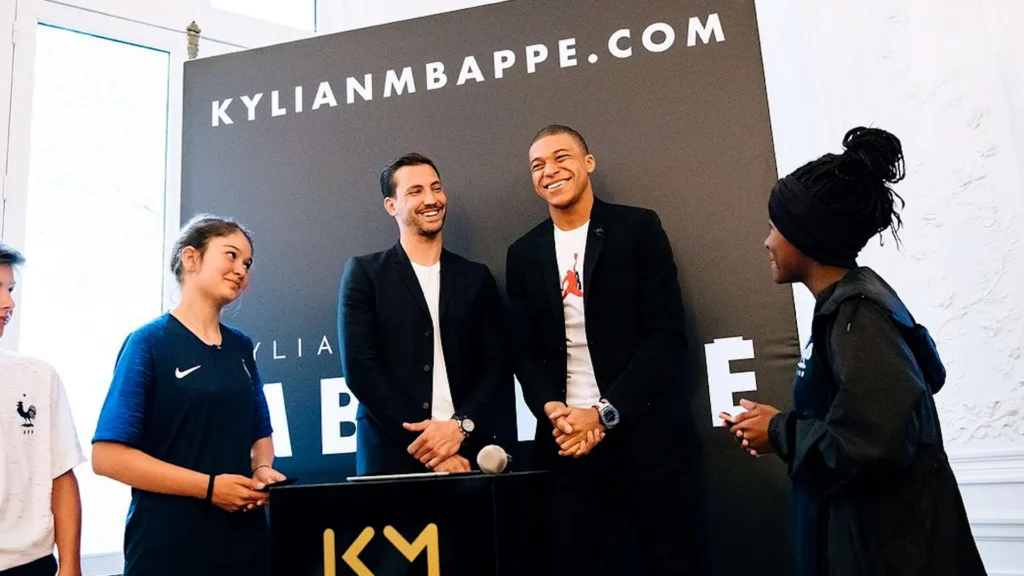
Coalition Capital: from ambassador to co-builder
The investment vehicle, Coalition Capital, currently holds six positions: a majority stake (~80%) in SM Caen, a minority position in Sorare, a minority stake in Loewe Electronics, a newly announced stake in Alan (the digital health insurer, which raised €100M at a €5B valuation in March 2026), and co-founding roles in Zebra Valley (content production) and KM Influence (athlete image rights management).
The portfolio logic is not random. Sorare gives him exposure to the intersection of football and digital assets. Alan places him in a sector — health insurance — with structural growth and brand affinity among the professional class his audience represents. Zebra Valley is a direct monetization of the content infrastructure he has built. And SM Caen, while modest in current value, establishes a foothold in club ownership that could scale if French football’s commercial trajectory improves.
The Alan deal is the most strategically significant of the recent moves. It is not an ambassador arrangement with a small equity kicker — it is a genuine investor position in a company at a serious valuation, announced with enough market visibility to affect Alan’s brand. The athlete-as-co-builder model is distinct from the athlete-as-endorser model in one key way: it generates returns independent of his playing career.
Image rights: the scarcity model
In 2020, Mbappé refused to participate in French national team commercial activities unless the federation agreed to grant players control over their individual image rights during international windows. The dispute was resolved in his favour. It established a template that several other top players have since adopted.
The practical consequence is a brand portfolio built on deliberate scarcity. His current major sponsors — Nike, Dior, Hublot, Oakley, EA Sports — are all positioned at the premium end of their respective categories. There are no fast-food partnerships, no mass-market betting affiliates, no volume plays. The sponsorship architecture prioritises brand equity over deal count, which means the per-deal value remains high and the aggregate remains coherent.
The Madrid tax layer
Spain’s Beckham Law — which offers a flat 24% rate on Spanish-source income for qualifying foreign workers — has excluded professional athletes since 2015. Mbappé cannot access it. He falls under the standard IRPF progressive schedule, which reaches 47% above €300,000 of annual income.
What partially offsets this is the Madrid Community’s Law 4/2024 — informally referred to as the Mbappe Law — which grants a 20% deduction on the regional portion of IRPF for non-residents who establish fiscal residence in the Community of Madrid and hold qualifying investments for a minimum of six years. The net effect depends on the composition and structure of his investment holdings, but the potential saving on the regional IRPF component (typically 9.5% of the applicable base) is material at his income level. The full mechanics are detailed here.
The philanthropy layer: Inspired by KM
His foundation, Inspired by KM, currently supports 98 children from underprivileged backgrounds — the same number as his shirt number at Monaco when he broke through. The foundation focuses on education and access rather than spectacle, which aligns with the low-profile personal brand he maintains outside sponsorship contexts.
The financial relevance is indirect but real: philanthropic credibility is increasingly a criterion for premium brand partnerships, particularly in the luxury sector where Dior and Hublot operate. It also hedges against the reputational risks that have destabilised comparable athlete brands.
Where this goes
The current trajectory points toward a net worth above €500M before the end of his playing career, assuming no major litigation losses and continued investment performance. The €263M PSG claim, if successful, would accelerate that timeline materially. The Coalition Capital portfolio, if even two or three of the six holdings generate serious exits, could dwarf salary earnings in the long run.
The more interesting question is structural. Mbappé’s model — family-controlled, equity-oriented, brand-disciplined — is genuinely different from what Ronaldo or Neymar built. It is less visible, more patient, and harder to replicate without the specific combination of elite market value and institutional legal support he has assembled. Whether it produces a billionaire before 35 depends less on football than on the exits his investment team engineers over the next decade.
For the detailed 2025 earnings breakdown — salary, bonuses, sponsorships, and effective tax rate — see Mbappé Won €110M in 2025 — Here’s What He Actually Kept. For the PSG litigation in full, see Mbappé vs. PSG: The Contract of the Century.
Deepen Your Intelligence
- Mbappé Net Worth 2026: €950M Earned — €300M Kept
- Coalition Capital: The Architecture of Mbappé’s Investment Empire
- Fayza Lamari: The Agent-Mother Who Built the Mbappé Business Empire

About the author
Victor Blanc
Football Business Correspondent at Mbappé Live. Covers contracts, sponsorships, investment strategy, and the financial architecture behind elite sport.