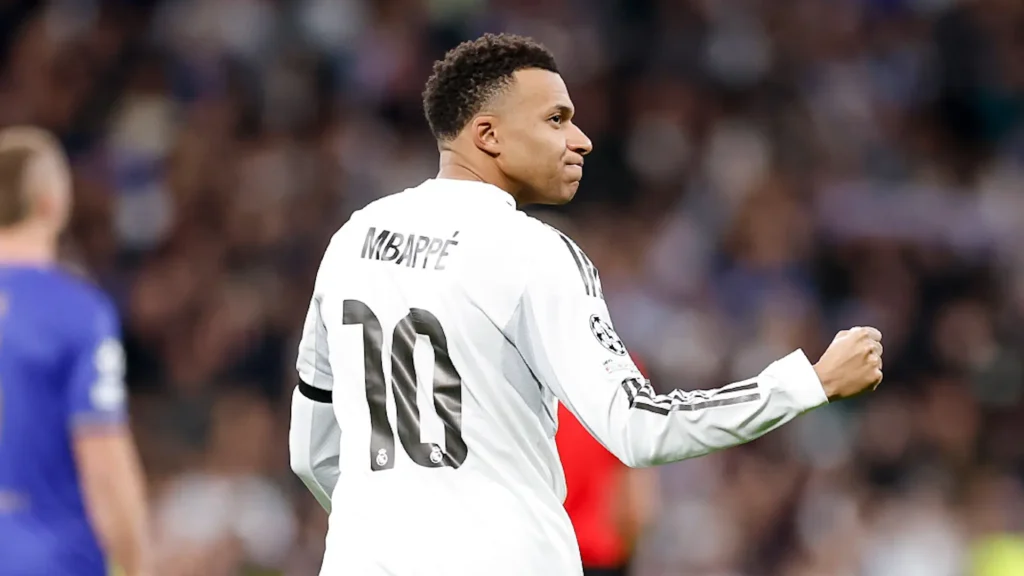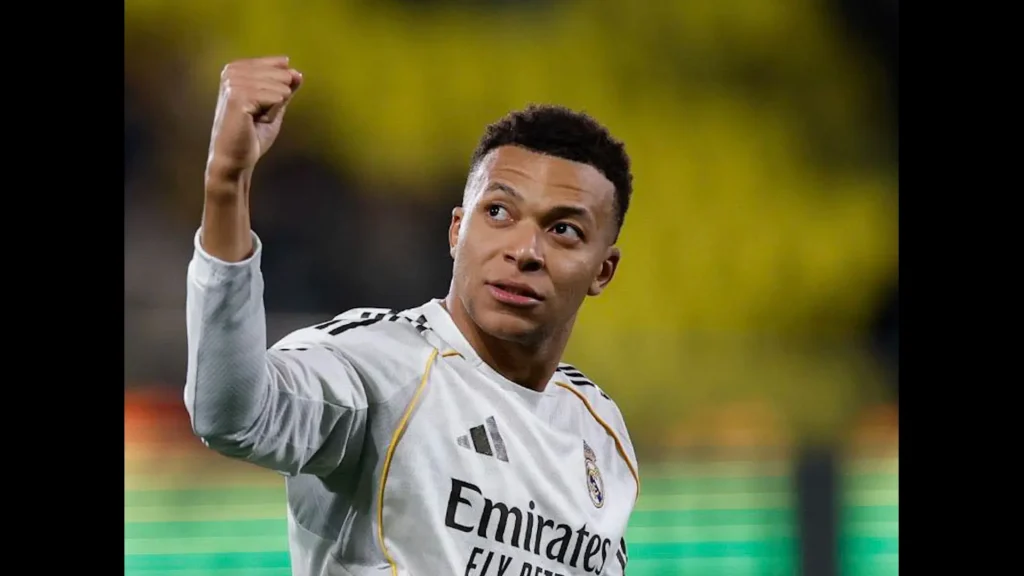
In 2013, Cristiano Ronaldo scored 59 goals for Real Madrid. For over a decade, that number stood as the record for a single calendar year in the club’s history. In 2025, Kylian Mbappé matched it exactly. The natural question is whether matching the number means matching the performance — and the data gives a more nuanced answer than the headline suggests.
The raw totals: identical surface, different texture
Mbappé’s 59 goals in 2025 were distributed across La Liga (39), the Champions League (14), Copa del Rey (4), Spanish Supercup (1), and Club World Cup (1). He achieved this across 59 appearances, for an exact average of 1.00 goal per match. Ronaldo’s 59 in 2013 came in 50 appearances — a rate of 1.18 per match. On pure efficiency, Ronaldo’s season was denser.
The context matters. Ronaldo’s 2013 was the product of a striker at the absolute peak of a very specific type of game: high-volume shot generation, penalty-area dominance, aerial threat, and a set-piece output that accounted for a significant share of his total. Mbappé’s 59 came from a different profile: pace-driven, high-transition, with a shot selection that is far more conservative. His xG overperformance in 2025 — converting chances well above their expected value — reflects precision rather than volume.
Carry rate: how much the team depends on him
One metric where Mbappé’s 2025 stands out clearly is his share of Real Madrid’s total goals. Of the 142 goals scored by the club across all competitions in 2025, Mbappé contributed 41.5%. The remaining 58.5% came from a squad that includes Vinícius Júnior, Jude Bellingham, and Rodrygo. That carry rate is exceptionally high for a team of this depth.
Ronaldo’s 2013 carry rate at Madrid was comparable — he was similarly dominant in a squad that also contained Benzema, Di María, and Özil. In both cases, the team built around a single focal point. The key difference is structural: Mbappé has operated under a system that asks him to share the left channel with Vinícius in a way that Ronaldo never had to negotiate at the peak of his Madrid career.
Champions League comparison: Mbappé’s clearest edge
The Champions League is where the comparison shifts decisively in Mbappé’s favour. Ronaldo’s 2013 UCL output was strong but not historically anomalous. Mbappé’s Champions League trajectory at Madrid is already elite by any historical standard: 68 career UCL goals in 96 appearances place him sixth all-time, at an age when Ronaldo had not yet reached those totals.
In the current 2025–26 UCL campaign alone, Mbappé has 13 goals in 9 appearances — the campaign’s top scorer by 3 goals, with Real Madrid reaching the quarter-finals against Bayern München in April 2026. His xG overperformance in the UCL this season (9.19 xG vs 13 actual goals) is the most pronounced of any player in the competition. For the full statistical breakdown, see our xG efficiency analysis.
The question the numbers don’t answer
Goals-per-game and carry rate measure what happened. They don’t fully capture what each player meant to the teams they played in, or the quality of opposition faced in decisive moments. Ronaldo’s 2013 season produced a Liga title and a Copa del Rey, but not a Champions League — which remains the trophy most associated with his Real Madrid legacy, and which he won in subsequent years.
Mbappé’s parallel question — whether his Madrid career will produce the UCL title that would complete the comparison — is still open. The 2025–26 quarter-final run is the most serious opportunity to date. Whether the goal rate translates into European silverware is the variable that will ultimately define how this comparison is settled.
For the commercial dimension of what a UCL title with Mbappé would mean for his brand value and sponsorship earnings, see our 2025 earnings analysis.
— Victor Blanc | Mbappé Live
Deepen Your Intelligence
- The Data Proof: Why Mbappé is the World’s Most Efficient Finisher
- Mbappé’s Real Madrid Contract: €150M Signing Bonus, 80% Image Rights
- Mbappé at the 2026 World Cup: The Complete Guide

About the author
Victor Blanc
Football Business Correspondent at Mbappé Live. Covers contracts, sponsorships, investment strategy, and the financial architecture behind elite sport.