BUSINESS & BRAND
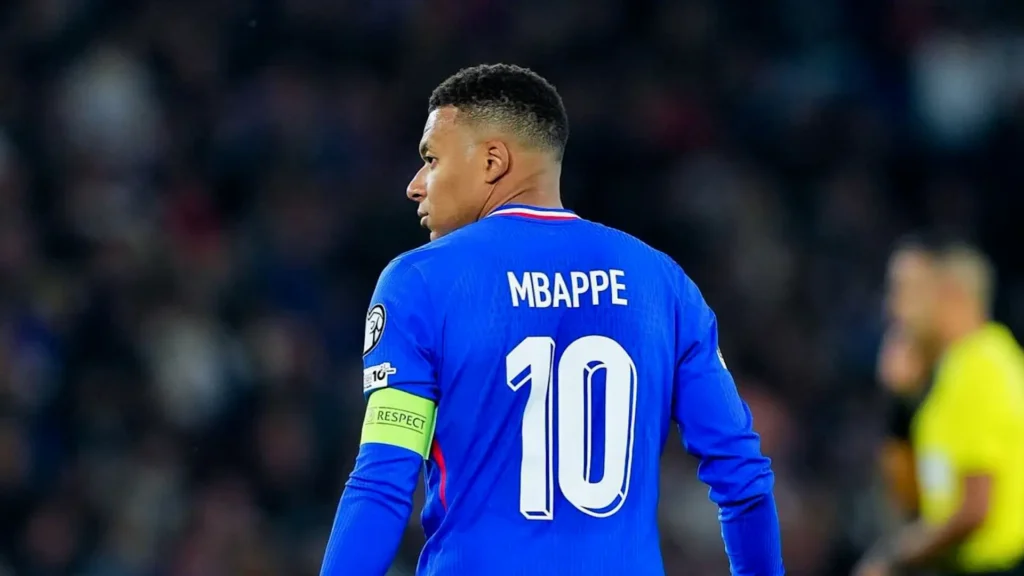
At Gillette Stadium in Foxborough on March 25, 2026, Mbappe faced an American press room and answered every question in English — fluently, spontaneously, with a joke about soccer. Messi has never done this. Ronaldo tried. Zidane never did it once. The language gap between Mbappe and every other elite footballer of his generation is a commercial asset worth tens of millions of dollars that almost nobody has quantified.
What happened in Foxborough
The scene was Gillette Stadium, home of the New England Patriots, on the eve of France vs Brazil. The press room was American — local TV reporters, Boston-based journalists, people who cover the Patriots and the Red Sox and happen to be covering football because the World Cup is coming to their city. Mbappe walked in, sat down, and for the next several minutes answered every question in English.
Not halting, translated-in-his-head English. Not the cautious, one-sentence English that elite athletes deploy when they want to avoid being misquoted. Flowing, spontaneous, idiomatic English, with subordinate clauses and cultural observations. When asked about the atmosphere he expected at the match, he said: “I don’t want to lie, I have absolutely no idea. I have no idea what the atmosphere is going to be. That’s why it is good to come here now before the World Cup — to have an idea of what we can have this summer. It’s going to be new for us.”
On Boston specifically: “Not only about football but also for culture. For many of us it’s our first time here in Boston, so we know nothing about Boston, nothing about the city. So it’s an opportunity as a person to learn a new culture, a new city, and new people.”
And then, with a laugh, on the American football vs soccer debate: “To show it’s a wonderful sport and for American people to know us better — and to know more about football and not call it soccer anymore.”
That last line landed. It was timed, it was dry, it was delivered with the timing of someone who has thought about how to engage an American audience before entering the room. It was not a translation. It was communication.
The comparison that matters: Messi, Ronaldo, Zidane
Consider what the Foxborough press conference would have looked like with any other footballer of comparable stature.
Lionel Messi, despite two decades at the summit of world football, has never given a press conference in English. His command of the language is minimal. At Inter Miami, he communicates with American journalists through an interpreter. In all his years at Barcelona, his global press interactions were conducted in Spanish or Catalan. The world’s greatest footballer, statistically, has never once addressed an English-speaking press room without a translator between him and the question.
Cristiano Ronaldo speaks functional English — enough to navigate a post-match interview, to produce a few sentences at a sponsor event, to tell a journalist his team played well. His years at Manchester United and Real Madrid gave him a working vocabulary. But his English is carefully bounded. He does not freelance in it. He does not make jokes in it. He has never sat in front of an American press room and fielded twenty minutes of open questions without a prepared script. The difference between Ronaldo’s English and Mbappe’s English is the difference between surviving a language and inhabiting it.
Zidane, France’s only comparable figure in global football stature, gave his entire managerial career’s press conferences in French and Spanish. His English, by his own admission, was limited. The man who won three Champions Leagues as a manager never once held a press conference in English. Neymar, who has spent years in Europe, communicates almost exclusively in Portuguese. Mbappé’s PSG teammate Ousmane Dembélé, despite years in Barcelona and then Paris, does not operate in English at press level.
The pattern across elite football is consistent and almost universal: at the highest level of the sport, press conferences happen in the player’s mother tongue, with a translator where necessary. Mbappe is the exception. He has been the exception for years — but the Foxborough press conference, staged in an American city ahead of a tournament that will be played across the United States, Canada, and Mexico, made the exception impossible to ignore.
Where the English came from — and what he said about it
Mbappe addressed his own linguistic philosophy directly in an interview with Thierry Henry that predates the Foxborough press conference by several years. Henry asked him about his language skills, specifically his Spanish. Mbappe’s answer revealed the strategic framework behind what looks, from the outside, like natural talent. “Yes, it’s very good. It’s because I want to be a great footballer and someone of importance. Today, you can’t be an international star and speak only French. That doesn’t make sense. You have to know how to adapt in all circumstances.”
The framing is instructive. Language, for Mbappe, is not an incidental skill. It is a deliberate component of what it means to be an international star. The decision to learn English and Spanish was as strategic as the decision to retain 80% of his image rights at Real Madrid or to structure Coalition Capital around equity rather than endorsement fees. It is part of the same architecture: the deliberate construction of a brand that operates at the highest possible level across the largest possible number of markets.
He speaks French natively. Spanish fluently, developed through his years at PSG alongside Messi, Neymar, and a predominantly Spanish-speaking dressing room. English at near-native level. Portuguese well enough for direct communication with Brazilian teammates. Four languages, each one a market. None of them accidental.
The commercial value of speaking English in America in June 2026
The 2026 World Cup is played in the United States, Canada, and Mexico. France’s group stage matches are in New Jersey, Philadelphia, and Boston — the same Foxborough stadium where Mbappe held his English-language press conference in March. The commercial activation window for his sponsors runs across the most valuable English-language advertising market on earth.
Every press conference Mbappe holds in English during the tournament generates something that no other player in the competition can generate at the same scale: direct, unmediated access to the American sports media. When Messi scored at the 2022 World Cup, American journalists filed their stories and moved on. When Mbappe speaks in English in New Jersey, he can be quoted directly, clipped without translation, embedded in American sports podcasts and television segments without a language barrier. The friction that normally exists between European football stars and the American sports media does not exist for Mbappe. That frictionlessness is commercially valuable in ways that are difficult to model precisely but not difficult to understand directionally.
Nike, whose headquarters are in Beaverton, Oregon, is activating in its home market around its primary football face. EA Sports, whose primary market is North American, is building campaign assets around a player who can speak to American audiences directly. Hublot, which has a flagship retail presence in New York and Los Angeles, is marketing a brand ambassador who can do interviews in English without an intermediary. The operational simplicity of a multilingual athlete at a US-hosted World Cup is not a minor advantage. It is a structural one.
The full commercial breakdown of why the US location matters for Mbappe’s brand covers the broader activation mechanics. The language dimension is the dimension that most analyses miss entirely, because it is invisible until you see the alternative — a press room in Boston, a question in English, and the most commercially valuable footballer in the world answering it, fluently, without stopping to think, with a joke at the end.
— Victor Blanc, Football Business Correspondent
Deepen Your Intelligence
- Mbappe’s Identity Is Not a Label — It’s a Market
- Mbappe at the 2026 World Cup: The Complete Guide
- Kylian Mbappe Financial Empire: The Strategic Breakdown
About the author
Victor Blanc
Football Business Correspondent at Mbappé Live. Covers contracts, sponsorships, investment strategy, and the financial architecture behind elite sport.