Kylian Mbappé has fewer commercial sponsors than almost any athlete at his level of global recognition. That is not an oversight. It is the central mechanism of his brand strategy — and understanding why requires looking at the portfolio not as a list of logos, but as an architecture with a coherent logic.
The scarcity model: why fewer deals generate more value
The standard commercial blueprint for a global football superstar is volume: a sportswear deal, a watch, a car brand, a gaming partnership, a phone company, a fast-food activation, a betting affiliate. The list is long, the revenue is diversified, and the individual deal values are correspondingly diluted by the sheer number of associations competing for attention.
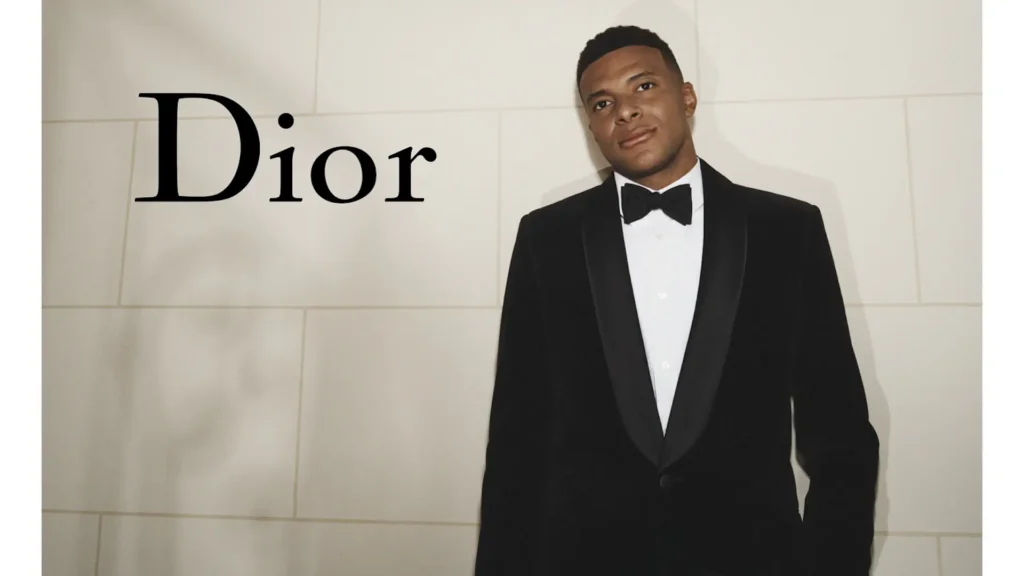
Mbappé’s team has rejected that model entirely. His current active portfolio is deliberately narrow: Nike, Hublot, Dior, Oakley, and EA Sports — all positioned at the premium end of their respective categories. There are no fast-food partnerships, no betting affiliates, no mass-market consumer electronics deals. Sports business analyst Jean-Baptiste Guegan, speaking to The Athletic, characterised the strategy as rooted in a strict curation of partners that correspond to his values and allow him maximum control over his narrative.
The commercial consequence is higher per-deal value. When a brand knows it is getting exclusive access to an athlete who says no to most categories, and whose existing portfolio is coherently premium, the price of association rises. Estimated annual sponsorship income from the current portfolio: €25 to €30 million, from five partnerships. That is a higher yield per deal than most athletes extract from ten or twelve. For a comparison with how he monetises — or rather fails to monetise — his social audience, see our analysis of Mbappé’s $50M social blind spot.
Nike: the infrastructure partnership
The Nike relationship predates everything. Mbappé signed his first Nike contract at age 12 and has been continuously associated with the brand since. The current deal — a nine-year agreement estimated at approximately €30 million total, substantially underpriced by current market standards — includes the development of a personal “KM” signature line, placing him alongside Michael Jordan, LeBron James, Rafael Nadal, and Tiger Woods in a circle of athletes with bespoke brand programmes.
The signature line is the most strategically significant element. It creates commercial infrastructure that continues generating revenue independent of playing performance, long after the playing career ends. This is why the renewal negotiation in 2026 — when his current Nike contract expires on July 31, days after the World Cup final — matters so much. Switching to Adidas or another brand would require rebuilding that infrastructure from scratch. For the full analysis of what the renewal decision involves, see our sneaker war analysis.
Hublot: the luxury tier signal
At 19, Mbappé joined Hublot’s ambassador circle — a deliberate step into the Swiss luxury watchmaking world that positioned him alongside Pelé among the brand’s historical faces. The Hublot relationship is not primarily about the financial value of the deal (modest relative to his overall commercial income). It is a positioning signal: it anchors him in the luxury goods space, which is where Dior and the LVMH adjacency also operate.
The coherence between Hublot (premium Swiss watchmaking), Dior (French luxury fashion), and Rimowa (premium luggage) is not accidental. These brands share a customer — high-net-worth, globally mobile, design-conscious — and their association with Mbappé reinforces each other’s premium positioning within his portfolio. No single deal creates that effect; the cluster does.
The Clairefontaine battle: how the image rights architecture was built
In 2022, Mbappé boycotted commercial photoshoots at the French national team training base at Clairefontaine. The trigger was a 2010 agreement between the FFF and its sponsors — which included KFC and the betting company Betclic — that required players to participate in promotional activities for those brands without individual consent.
Verheyden led the legal challenge, arguing that players should have control over their individual image rights during international windows, and that the existing collective agreement conflicted with those rights. The FFF initially resisted; the standoff became public and contentious. It was eventually resolved in Mbappé’s favour: the federation revised its image rights structure, granting individual players greater control over their commercial associations during international duty.
The practical impact extended beyond Mbappé. Several other senior French players adopted similar positions following the dispute. It established a template for how top athletes can assert image rights sovereignty within collective labour structures — and it cemented Verheyden’s reputation as one of the most effective sports lawyers in Europe. For her full profile, see our Verheyden analysis.
The 2026 horizon: what changes at peak commercial moment
The Nike renewal is the single most consequential commercial decision of Mbappé’s off-pitch career in 2026. But it sits within a broader portfolio review that will happen in the period surrounding the World Cup. Sponsors whose deals are expiring or approaching renewal will be evaluated against the principle that has governed the portfolio since the beginning: does this association strengthen the premium positioning, or does it dilute it?
The answer to that question, applied consistently, is what has built a portfolio worth €25 to €30 million per year from five partners. The same principle, applied at the peak commercial moment of his career — 27 years old, World Cup summer, at the height of his market value — will determine whether the off-pitch architecture compounds further or plateaus. For the full financial picture, see our 2025 earnings breakdown.
— Victor Blanc | Mbappé Live
Deepen Your Intelligence
- Nike, Adidas, or Puma? The €100M+ Decision Mbappé Has to Make Before the World Cup
- The $50M Blind Spot: Mbappé Has 165 Million Followers and Almost Nothing to Show for It Commercially
- Mbappé Net Worth 2026: €950M Earned — €300M Kept
- Mbappé at the 2026 World Cup: The Complete Guide
- Fayza Lamari: The Agent-Mother Who Built the Mbappé Business Empire

About the author
Victor Blanc
Football Business Correspondent at Mbappé Live. Covers contracts, sponsorships, investment strategy, and the financial architecture behind elite sport.