Cristiano Ronaldo earns an estimated $3 million per Instagram post. Neymar Jr. commands over $1 million. Even mid-tier footballers with engaged audiences of 20 to 30 million followers routinely generate $5 to $10 million per year through social media partnerships alone. Kylian Mbappé has 165 million followers across Instagram and X combined — the largest social media audience of any active footballer — and monetises almost none of it through direct social commerce. Industry estimates put the gap between his actual social media income and his theoretical ceiling at $40 to $60 million per year.
The audit: what his social presence actually looks like
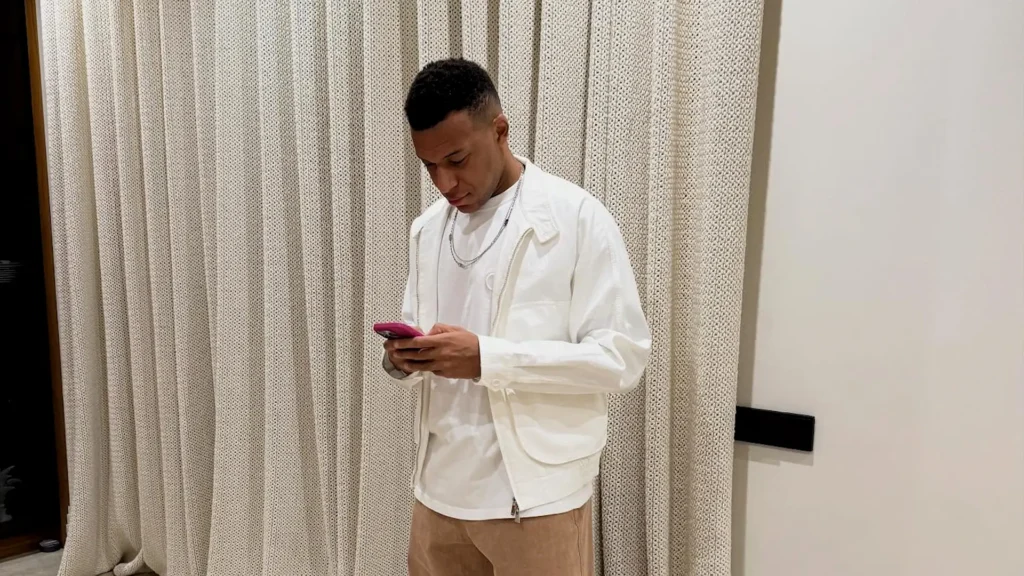
Mbappé’s Instagram is technically active but practically sparse. Posts are infrequent — typically three to six per month compared to Ronaldo’s daily output — rarely personal, and almost never product-forward. There are no unboxing videos, no training day vlogs, no branded partnership posts of the type that generate seven-figure fees for comparable athletes. His TikTok presence is minimal. His X activity is sporadic, and when it does surface, it is typically a brief reaction to a match result or a calculated intervention on a political or cultural issue.
The contrast with his immediate peers at Real Madrid is striking. Jude Bellingham, two years younger and with a smaller trophy cabinet, has built a consistent high-engagement content operation. Viniícius Júnior has leveraged cultural authenticity — Brazilian music, dance, community — into a passionate global following that amplifies his sponsor relationships. Both are outpacing Mbappé’s digital output per follower by a significant margin.
The scarcity argument: is the silence a strategy?
There is a credible case that the silence is deliberate and strategically coherent. In luxury branding, scarcity creates value: a Hermès Birkin bag is not marketed aggressively, and the limited access is part of what makes it expensive. Mbappé’s social media presence may be operating on a similar logic — keeping his digital footprint rare enough that each appearance carries disproportionate weight. The Fayza Lamari team has demonstrated sophisticated brand management across multiple domains; it would be surprising if the social media strategy were simply neglect rather than a considered position.
The scarcity model works well for luxury goods. Its application to social media is less clear. The athletes who have successfully used low-frequency posting to maintain premium brand value — Michael Jordan during the later stages of his career, Roger Federer — did so after decades of high-visibility presence that had already established the brand. Mbappé is 27. He is still in the phase where the brand is being built, not where it can be maintained by absence.
The infrastructure argument: what may actually be missing
The less flattering reading is structural rather than strategic: the content infrastructure — editors, videographers, social strategy, platform-specific content pipelines — simply has not been built. Running a serious social media operation at the level of a 165-million-follower athlete requires a dedicated team of five to ten people working full-time. It requires relationships with platform algorithm teams. It requires the willingness to accept that content quality will be variable, and to post anyway.
The Mbappé network is excellent at legal architecture, contract negotiation, and brand curation. Whether it has the operational capability for systematic content production is a separate question. These are different skills, and it is possible to be world-class at one and absent from the other.
The World Cup window: why 2026 is the moment
The summer 2026 World Cup in the United States, Canada, and Mexico represents the highest-concentration commercial moment of Mbappé’s career. Every major sponsor will be watching engagement metrics as closely as goals scored. The brands bidding on Nike’s renewal — Adidas, Puma, potential lifestyle wildcards — will have modelled the social media engagement data in their valuations. A player with 165 million followers who generates minimal engagement per post is worth materially less to a performance-marketing dependent brand than a player with 80 million followers who drives consistent clicks and sales.
The Nike deal renewal is valued in part on the commercial infrastructure he brings to the partnership. If that infrastructure remains underdeveloped on the social layer, the renewal negotiation is weaker than it should be. The opportunity cost is not abstract. It is embedded in the fee the next contract will generate — or fail to. For the full commercial picture of his 2025 earnings, see our earnings breakdown.
— Victor Blanc | Mbappé Live
Deepen Your Intelligence
- Mbappé’s Sponsorship Portfolio: Nike, Dior, Hublot
- Kylian Mbappé Financial Empire: The Strategic Breakdown
- Mbappé Net Worth 2026: €950M Earned — €300M Kept

About the author
Victor Blanc
Football Business Correspondent at Mbappé Live. Covers contracts, sponsorships, investment strategy, and the financial architecture behind elite sport.