Kylian Mbappé has been a Nike athlete since the age of eight. That relationship — nearly two decades old — expires on July 31, 2026, within days of the World Cup final in the United States. The timing is not incidental. It places the renewal negotiation at the exact moment of maximum commercial leverage: an athlete at peak market value, headlining the tournament’s decisive game, with every major sportswear brand watching.
What Nike is defending
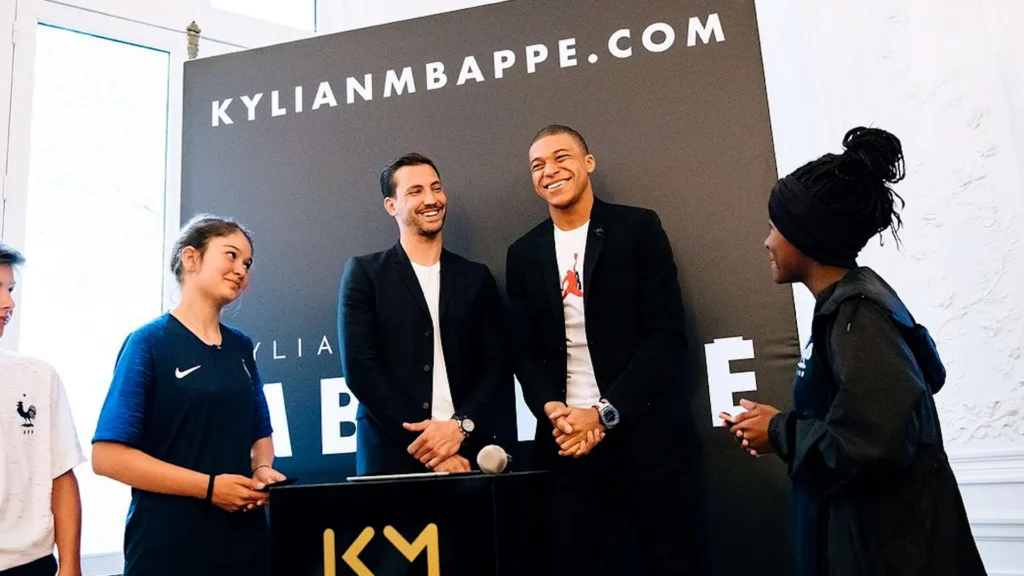
Nike’s position with Mbappé is structurally irreplaceable. His current deal, a nine-year contract valued at approximately €30 million total (a figure that significantly underprices his current market), includes the right to develop a personal “KM” signature line — placing him in a circle that includes Michael Jordan, LeBron James, Rafael Nadal, and Tiger Woods. That signature line infrastructure, once established, has compounding commercial value that extends decades beyond an athlete’s playing career.
Nike’s strategic incentive to retain him is amplified by what is happening elsewhere in their football portfolio. Cristiano Ronaldo — their most commercially significant football association for two decades — is in the final phase of his career in Saudi Arabia. Lionel Messi signed with Adidas decades ago and remains there. Nike needs a generational face for football at peak relevance. Mbappé, at 27 and about to lead France at a home-confederation World Cup, is that face.
The French Football Federation’s €100 million-per-year kit deal with Nike, extended through 2034, adds a commercial layer. A France captain wearing Adidas boots during a Nike-kitted tournament creates a visual tension that brand teams spend significant resources trying to avoid.
The Adidas case: Real Madrid synergy and the financial gap
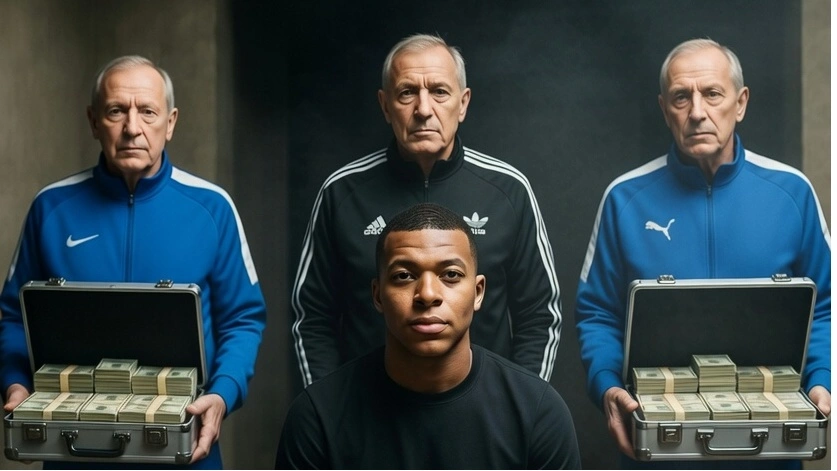
Adidas’s argument is not speculative — it is structural. Real Madrid plays in Adidas kits. A player wearing Adidas boots in an Adidas shirt generates integrated brand exposure that competing brands cannot replicate in the same frame. During his previous contract renewal, Adidas reportedly offered at least €20 million more per year than Nike. Mbappé declined. Whether that calculus changes in 2026 depends on how much weight he places on the existing KM line infrastructure versus the raw financial gap.
The complication for Adidas is the France national team. Signing Mbappé would mean their contracted athlete wears a rival brand’s kit every time he plays internationally — the FFF deal runs to 2034, well past his likely retirement. Brand managers at Adidas will have modelled whether the Real Madrid synergy offsets the international fragmentation. Their answer will shape how aggressively they bid.
What the market benchmark says about the numbers
The reference points for a Mbappé deal are limited but instructive. Nike’s recent decade-long extension with Erling Haaland is reported at over €20 million per year — the current ceiling for a boot deal without a signature line attached. Tiger Woods’ Nike deal ran at approximately €20 million per year across the 2013–2023 period, before he moved to Sun Day Red at TaylorMade. LeBron James’ lifetime deal with Nike, signed in 2016, is valued at over €1 billion across 20+ years — the benchmark for what a signature line programme can be worth to both sides.
Mbappé’s current contract underprices him by a significant margin. The most conservative credible estimate for a new five-year deal — accounting for the KM line’s established revenue, his current market value of €200M, and 165 million social media followers representing 40% of the entire French national team’s combined digital audience — is €20 to €30 million per year in base retainer. With performance bonuses and KM line revenue sharing included, the five-year total could reach €100 to €150 million.
The wildcard: the Federer model
In 2018, Roger Federer — the most commercially pristine athlete of his generation — left Nike after 24 years for Uniqlo, a Japanese lifestyle brand with no tennis heritage. The reported value was €30 million per year for a 10-year deal, with no equipment obligation — Federer still used Wilson rackets. The move was not about sport; it was about brand positioning in the post-playing career he was already building.
The parallel for Mbappé is not precise — a boot deal requires actual boot wear, and football is more equipment-visible than tennis — but the underlying logic is relevant. His management team has consistently demonstrated willingness to structure deals around long-term brand architecture rather than short-term financial maximisation. A partnership with a luxury or lifestyle brand at premium terms, with a bespoke product collaboration, is not implausible. It is, however, the least operationally straightforward option given that he will need to wear boots manufactured by whoever signs him.
The likely outcome
Nike retains the structural advantage. The KM line infrastructure represents years of investment that would be lost — or at minimum disrupted — by a switch. The FFF alignment adds a second layer of institutional logic. And Nike’s desperation to retain him after Ronaldo’s effective withdrawal from their active portfolio means they are, by competitive necessity, willing to close the financial gap with Adidas.
The deal that gets signed will be watched as a benchmark for the next generation of elite football sponsorship structures. For the full picture of his current sponsorship portfolio and the strategic logic behind each partnership, see our sponsorship intelligence report.
Deepen Your Intelligence
- Mbappé’s Sponsorship Portfolio: The Strategic Logic Behind Nike, Dior, and Hublot
- Mbappé at the 2026 World Cup: The Complete Guide
- Mbappé Net Worth 2026: €950M Earned — €300M Kept

About the author
Victor Blanc
Football Business Correspondent at Mbappé Live. Covers contracts, sponsorships, investment strategy, and the financial architecture behind elite sport.