BUSINESS & BRAND
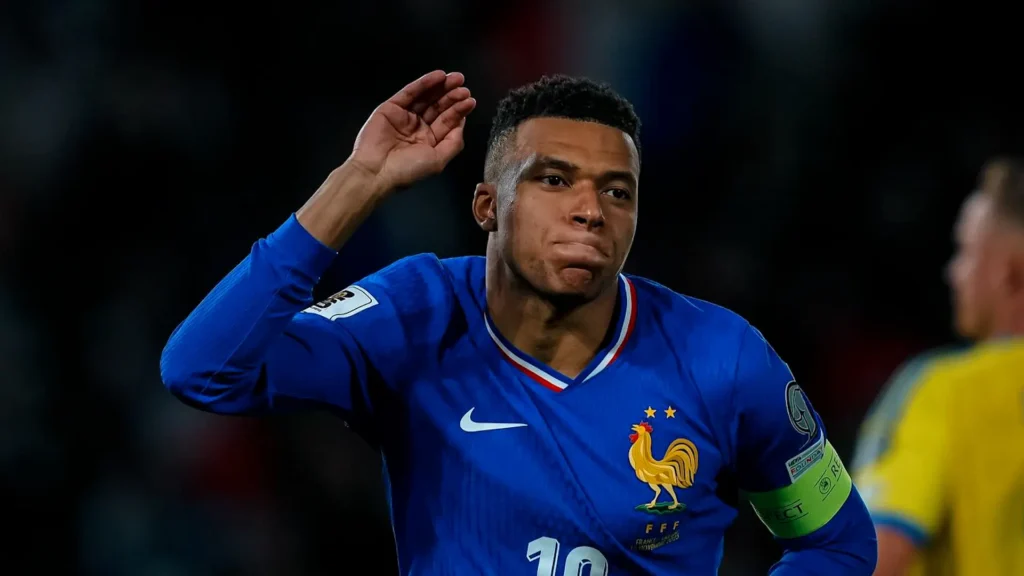
Kylian Mbappe arrives at the 2026 World Cup with 12 tournament goals, one hat-trick in a final, and five goals between him and the all-time scoring record. France are tournament favourites. His Nike contract expires the day after the final. The financial and sporting stakes have never been higher for a single player at a single tournament.
What is at stake on the pitch
Mbappe enters the 2026 World Cup as the most statistically productive forward in tournament history on a per-game basis. His 12 goals in 14 appearances include a hat-trick in the 2022 final against Argentina — the most consequential individual performance in a World Cup final since Geoff Hurst in 1966. France lost on penalties. That result sits unresolved at the centre of his legacy.
Two records frame the tournament. Miroslav Klose holds the all-time World Cup scoring record with 16 goals across four tournaments. Mbappe needs five in a single tournament to match it — a number he has come within two of already. The financial implications of breaking the Klose record extend well beyond the trophy: it would make him the defining footballer of his generation in a way no club achievement can replicate.
The second record is closer. Olivier Giroud’s all-time France scoring record of 57 goals has stood since 2022. Mbappe is at 56 — one goal away from equalling it, two from standing alone as France’s greatest scorer. He will almost certainly break it before the tournament ends. The commercial implications of that milestone are substantial and underanalysed.
France open against Senegal on June 9 at MetLife Stadium in New Jersey — a match that carries more tactical and narrative weight than a routine group opener. The full preview of that fixture covers why a slow start could destabilise an entire tournament campaign.
The financial architecture of a World Cup year
The last time the United States hosted a World Cup was 1994 — before the Premier League’s global expansion, before streaming, before social media, and before the American sports market became the most commercially valuable advertising territory on earth. The 2026 edition returns to the same geography with an audience and a commercial infrastructure that have no equivalent in the tournament’s history. For Mbappe specifically, whose sponsors sell into the American market and whose image rights activate on American soil at scale for the first time, the location is a structural advantage. A full breakdown of why the location matters commercially goes further into the brand activation mechanics.
FIFA has set a record $50 million prize for the 2026 winner. France’s federation, the FFF, has already restructured its player bonus system at Mbappe’s request as captain. The goal-by-goal breakdown of what the tournament is worth to Mbappe — combining federation fees, FIFA prize share, and sponsor activation clauses — puts the total figure in the range of €35-60 million depending on how deep France go.
His sponsorship contracts are not standard annual deals. Nike, EA Sports, Dior and Hublot all contain milestone clauses that only activate during World Cup summers. The structure of those contracts — performance triggers, activation windows, exclusivity clauses — is the least-covered dimension of his commercial profile.
One deadline sits above all others: Mbappe’s Nike boot deal expires on July 31, 2026 — days after the World Cup final. He will be 27, at peak commercial value, having just played on the largest stage in sport. The sneaker war that follows could produce the largest boot deal in football history. The negotiation is already underway.
What a France victory would change
The scenario modelling on Mbappe’s commercial value after the tournament produces a wide range depending on outcomes. The full projection runs three scenarios: France win with Mbappe as top scorer, France exit early, and Mbappe injured. The spread between best and worst case is approximately €80 million in commercial earnings over the following 12 months.
A World Cup win would also resolve the Ballon d’Or question that has followed him since 2022. The case for why 2026 is his best and possibly last opportunity rests on the convergence of factors that will never align again in the same way: the right age, the right tournament, the right narrative.
The legacy comparison that defines the tournament’s broader narrative is not Mbappe vs Giroud or Mbappe vs Klose. It is Mbappe vs Messi. Messi won his World Cup at 35, completing a career CV that had one gap. Mbappe faces the same defining moment at 27, with the physical peak of his career still ahead.
The risks: injury, Real Madrid, and the weight of expectation
Mbappe spent the first quarter of 2026 managing a misdiagnosed knee injury. Real Madrid’s medical team scanned the wrong knee. He played three matches on an injured leg before the correct diagnosis was made. The full medical and commercial timeline documents why this three-month period was the most consequential injury management episode of his career.
The institutional tension between Real Madrid and the French national team over player availability in June 2026 is structural, not incidental. The conflict between club and country — who controls Mbappe in the six-week window between the Liga season and the tournament opener — has financial implications on both sides that have not been fully reported.
Didier Deschamps will manage his fourth and final World Cup in 2026. His record — one win, two finals, one quarterfinal — sits in a specific relationship with Mbappe’s legacy. The case for why Mbappe needs this tournament to end with a trophy is both sporting and commercial.
— Victor Blanc, Football Business Correspondent
Deepen Your Intelligence
- Mbappe Needs 5 Goals to Break the All-Time World Cup Record — What That Means Financially
- France Could Win $50M at World Cup 2026 — Here Is Exactly What Mbappe Stands to Pocket
- Mbappe’s Net Worth After the 2026 World Cup: A Scenario-Based Projection

About the author
Victor Blanc
Football Business Correspondent at Mbappé Live. Covers contracts, sponsorships, investment strategy, and the financial architecture behind elite sport.