Religion and elite sport have always intersected — sometimes awkwardly, sometimes powerfully. For Kylian Mbappé, whose mother Fayza Lamari is Muslim and whose father Wilfrid is Christian, the question of faith sits at the centre of a commercial calculation that his team has navigated with considerable care. In a market environment where the Middle East and North Africa represent one of the most dynamic growth frontiers in global sports investment, Mbappé’s religious and cultural background is not a private matter. It is a brand variable.
The faith question: what is publicly known
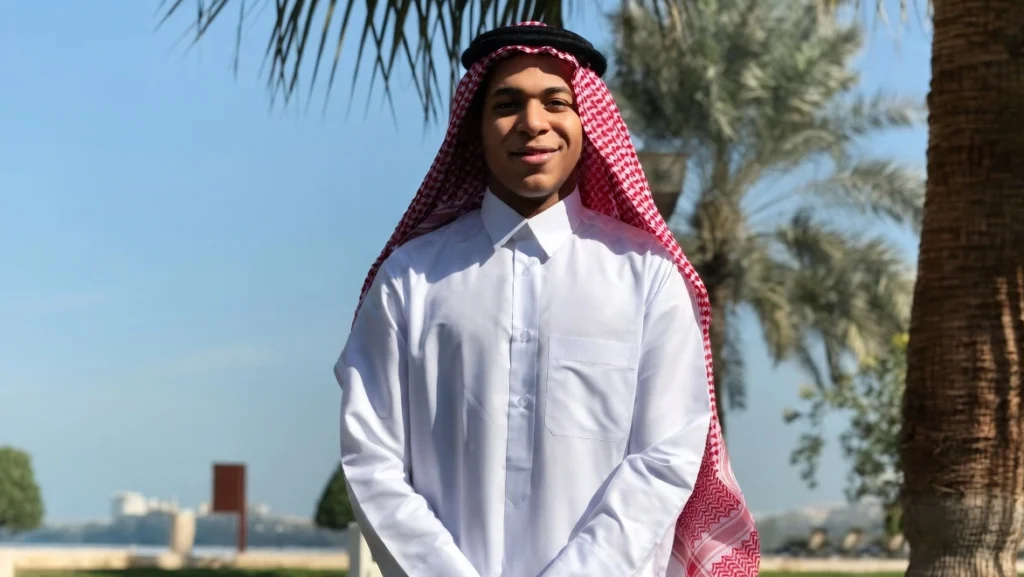
Mbappé has described himself as Christian, following his father. He does not observe Ramadan, which has periodically generated commentary — some supportive, some critical — from Muslim communities in North Africa and the diaspora who consider him culturally proximate. His mother’s Algerian-Kabyle heritage, and the Muslim context it carries, means that in the perception of millions of fans across North Africa and the Middle East, Mbappé is read as part of their world regardless of his stated faith.
That perception gap — between his own stated identity and how he is understood in key markets — is not a problem to be managed. It is, commercially, an asset. A player who is simultaneously readable as Western European, French, Algerian, and African covers more cultural territory than any single ethnic or religious identity could. For a detailed analysis of how the multicultural roots translate into brand positioning, see our multicultural identity analysis.
The MENA commercial context
Saudi Arabia’s Public Investment Fund has invested over $6 billion in sports assets since 2021 — Premier League clubs, LIV Golf, Formula One rights, and direct player contracts including the highest salary ever offered to a footballer (the €332 million Al-Hilal bid that Mbappé rejected in 2023). Gulf sovereign wealth funds are not investing in sport for sporting reasons. They are investing in the audiences those sports deliver, and in the athlete-as-media-property model that generates returns across brand exposure, tourism, and soft-power objectives.
In that context, an athlete with deep North African and MENA audience penetration is a commercially significant asset for any brand seeking to enter or expand in those markets. Mbappé’s popularity in Algeria, Morocco, Tunisia, and across the broader Arabic-speaking world is not primarily driven by football results. It is driven by identity — the perception that he represents something of their world, that his success is in some sense their success. That emotional connection is the foundation of commercial loyalty and it is not easily manufactured by signing a player without that cultural resonance.
The sponsorship calculus
Brands targeting MENA consumers — in luxury goods, financial services, automotive, fashion, and technology — factor perceived cultural affinity into their ambassador choices. An athlete who is genuinely beloved in North Africa and the Gulf generates more brand trust in those markets than one who simply appears in a regional campaign. The trust is earned, not paid for, and it accumulates across years of cultural proximity.
Mbappé’s dual positioning — credible as a global premium brand ambassador in European markets while simultaneously resonating as a cultural figure in MENA — is unusual and valuable. Nike, Dior, and Hublot primarily target the European and American high-net-worth demographic. A future MENA-specific partnership — a Gulf airline, an Islamic finance institution, a regional luxury brand — would find in Mbappé an ambassador with pre-existing cultural equity that no money can directly purchase. That is a different kind of commercial value, and it is not yet fully exploited in his current portfolio.
The 2026 World Cup amplification
The United States, Canada, and Mexico host the 2026 tournament — but the audience that will watch it most intensely in the MENA region will be watching Mbappé specifically. France are favourites; Mbappé is the captain and the primary narrative figure. The commercial visibility he will generate across North Africa and the Gulf during the tournament — through broadcast coverage, social media, and the cultural conversation that follows every match — represents a spike in MENA brand equity that his current sponsors are not positioned to capture, and that a future MENA-specific deal could be structured to monetise directly.
For the full picture of his current sponsorship portfolio and how it might evolve, see our sponsorship intelligence report.
— Victor Blanc | Mbappé Live

About the author
Victor Blanc
Football Business Correspondent at Mbappé Live. Covers contracts, sponsorships, investment strategy, and the financial architecture behind elite sport.