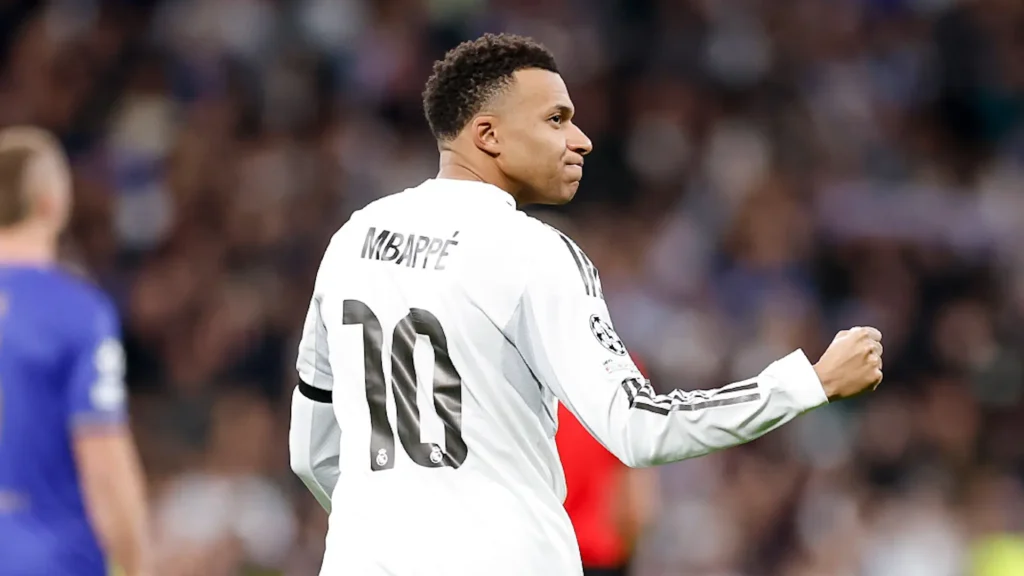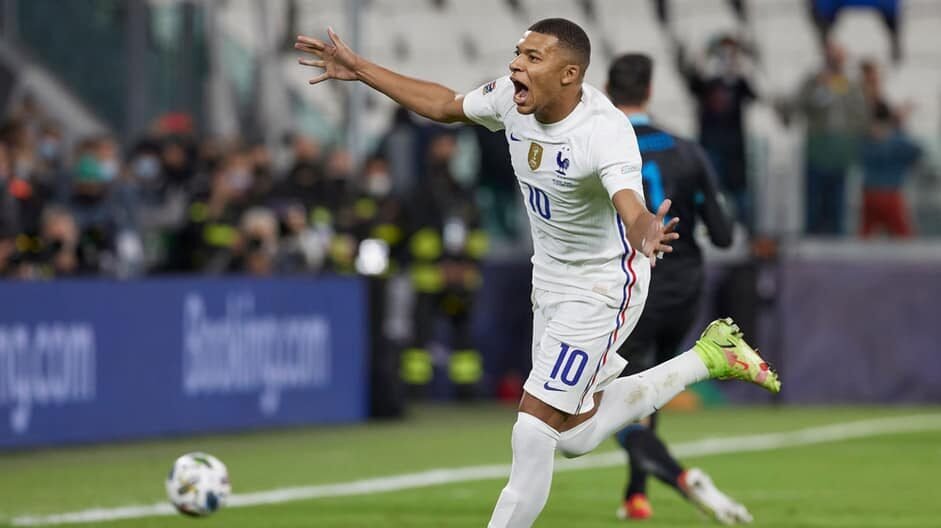
For years, the standard defensive instruction against Mbappé has been to force him onto his left foot. The statistical record suggests that instruction is based on a false premise. Out of his 332 career goals, 60 have been scored with his left foot — a figure that exceeds the career total of many elite European strikers scored with their dominant foot. The one-dimensional narrative has a data problem.
The 60-goal left foot: what the number means
Sixty left-foot goals represents 18% of his total output. For a player whose right foot accounts for 74% of his production, that proportion may seem modest. The relevant question is not the percentage but the rate: at what frequency does a player with a secondary foot produce goals from that foot, relative to the opportunities created? Mbappé’s left foot is not a weapon he deploys incidentally when cornered. It is a functional scoring instrument that defenders must account for when positioning.
The tactical consequence of a credible left foot is that it changes where defenders stand. If pressing a player onto their weaker side reliably reduces the goal threat, the defence adjusts. If it does not — if the weaker side still produces at a rate that demands defensive respect — the pressing instruction loses its value. Mbappé’s left foot has crossed that threshold. Sixty goals is enough to require defensive acknowledgement, which in turn creates space on the right that would not exist if defenders could ignore the left entirely.
The right foot: what 246 goals with one foot looks like
246 goals from the right foot, representing 74% of his career total, defines the primary finishing mechanism. The variety within that output is significant: the inside-cut curler to the far post (his highest-frequency technique), near-post power shots that eliminate reaction time, driven finishes from the edge of the penalty area on the half-turn. The right foot is not a single shot type; it is a toolkit. That versatility within the dominant instrument is partly what makes the overall output so difficult to defend — the approach patterns are predictable but the execution is not.
The aerial dimension: 22 goals that shouldn’t exist
At 178cm, Mbappé does not win aerial duels by height. He wins them by timing. His 22 headed goals are produced through movement in the approach — arriving at a point that defenders have not occupied because they have not tracked the run — rather than through physical contest at the peak of a jump. The technique is what coaches call “ghost running”: eliminating contact, exploiting the space between defenders at the moment of delivery. Twenty-two goals from a player whose aerial game was considered negligible represents a significant evolution. For the full career evolution breakdown, see our tactical development analysis.
The penalty record: 42 conversions and the pressure variable
42 successful penalties constitute a meaningful data point not for their technical difficulty — penalties are the lowest-pressure scoring opportunity in terms of defensive interference — but for what they indicate about mental consistency under visibility. Every penalty is taken with an entire stadium watching, full media coverage, and the knowledge that a miss will be the dominant narrative of the post-match. A player who converts 42 across a career that has included knockout stage misses (notably the PSG-Real Madrid UCL ties in the early 2020s) has demonstrated the capacity to return to that situation and perform regardless of previous outcomes. That profile is consistent with the broader pattern of his play in decisive moments.
What the complete profile says
The goal breakdown — 246 right foot, 60 left foot, 22 headers, 42 penalties from a total of 332 — is the data fingerprint of a forward who has been specifically developed to remove single points of failure from his game. The left foot is not at parity with the right; it does not need to be. It needs to be dangerous enough to force defensive decisions that create space for the right. It has cleared that threshold. The aerial game is not a strength; it is a functional supplement that requires defensive attention. The penalty record reflects mental consistency, not technical skill.
The player who emerges from this data is not one-dimensional. He is multi-dimensional in a specific, deliberately constructed way — with one dominant instrument and several secondary ones, each developed to the point where neglecting any of them creates an exploitable gap. That is a more useful description of what makes him difficult to defend than any reference to raw pace. For the tactical analysis of how he uses this profile in the 2025–26 season, see our xG efficiency breakdown.
— Victor Blanc | Mbappé Live
Deepen Your Intelligence
- The Data Proof: Why Mbappé is the World’s Most Efficient Finisher
- Mbappe at 27 Has 586 Goal Contributions. Messi Had 548. Ronaldo Had 378.
- Mbappe’s Goal Efficiency Evolution: From Bondy to Madrid Apex (2026)
- Kylian Mbappé’s Playing Style: The Complete 2026 Tactical Breakdown
- 2026 Benchmark: Is Mbappé Better Than Vinicius and Haaland?
- Mbappé at the 2026 World Cup: The Complete Guide

About the author
Victor Blanc
Football Business Correspondent at Mbappé Live. Covers contracts, sponsorships, investment strategy, and the financial architecture behind elite sport.