PERFORMANCE DATA
The sprint that launched the legend
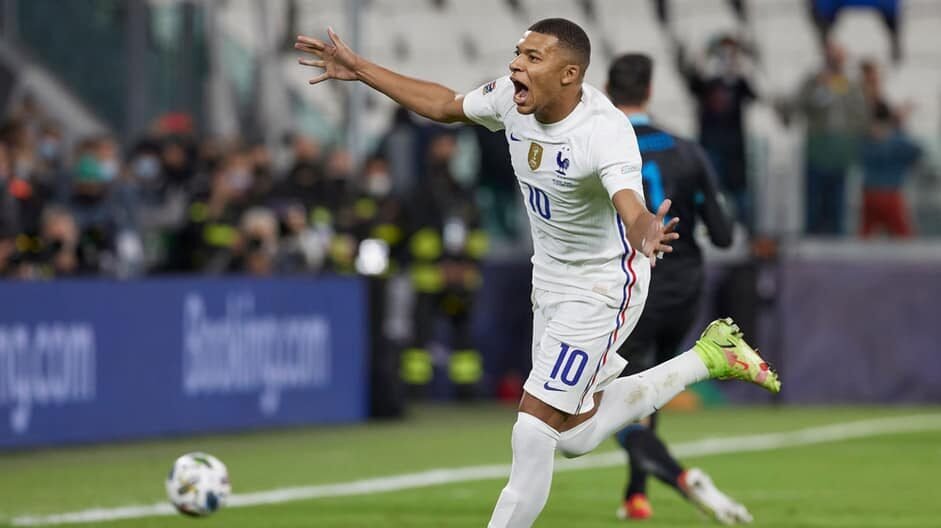
On July 4, 2018, France defeated Argentina 4–3 in the Round of 16 in Kazan. In the 57th minute, Mbappé received a pass in his own half, accelerated through two defenders, earned a penalty, and within seconds had the watching world reaching for superlatives.
Within hours, multiple media outlets were reporting his top speed during that sequence as 37 km/h — a figure that placed him alongside Olympic sprinters and made for an irresistible data point. By the following day, it had been broadcast on television across five continents and embedded in social media posts with millions of views. Sports marketing teams flagged it for future campaigns. Commentators memorised it.
Three days later, FIFA published its official statistical summary for the match. According to that document, Mbappé’s maximum recorded velocity was 32.4 km/h — a full 4.6 km/h below the widely circulated figure. Griezmann, who covered significantly more ground (35 sprints vs Mbappé’s 26), reached the same peak speed in that match. Dembélé and Kanté had both clocked 32.83 km/h in the France–Denmark game earlier in the tournament.
The official figure received a fraction of the coverage the original claim had generated. The correction, buried in a technical summary few journalists had reason to seek out, did not travel.
SPEED RANKING
Why the number stuck despite the evidence
Media speed figures in football rarely come from a single, centrally verified source. During live matches in 2018, broadcast providers, data analytics firms, and stadium tracking systems operated independently and with different methodologies. Optical tracking, GPS vest data, and camera-based systems could produce meaningfully different outputs from the same physical event. The 37 km/h figure almost certainly originated from one of these secondary systems — likely a broadcast data overlay — and was reported as fact.
What happened next is a standard information cascade. Once a compelling number appears in a credible outlet, subsequent articles cite that outlet rather than the underlying source. The figure becomes self-referencing. No journalist verifying Mbappé’s speed later that year needed to consult FIFA’s match report — they had dozens of existing citations pointing to 37 km/h. The original claim acquired the appearance of consensus.
It is also worth noting what did not happen: FIFA did not issue a press release contradicting the 37 km/h figure. Their match statistics are published in a technical format that presupposes readers who are already looking for them. The burden of discovery fell on the individual reader, not on the institution that held the correct number.
What the official record actually shows
As of 2026, the only publicly documented and officially sourced peak speed for Mbappé comes from a different competition entirely. At UEFA Euro 2024 in Germany, tournament tracking data recorded Mbappé at 36.5 km/h — placing him first in the speed ranking among all players at that tournament. That figure topped the ranking ahead of Ferran Torres (36.0 km/h), Šeško (35.9 km/h), and Mihăilă (35.8 km/h).
The Euro 2024 number is significant for two reasons. First, it establishes that Mbappé is genuinely among the fastest players in world football at senior international level — the ranking position is real. Second, it shows that his documented maximum sits around 36–36.5 km/h, not 37, and certainly not the even higher figures that have circulated in various contexts over the years.
For the 2018 World Cup specifically, the official FIFA figure of 32.4 km/h reflects a different kind of data point: not his absolute ceiling, but his verified top speed in that particular match as captured by the system FIFA was using at the time. The discrepancy with Euro 2024 likely reflects both genuine performance variation and the evolution of tracking technology over six years, rather than an error in either dataset.
The commercial consequences of a ghost statistic
For a player of Mbappé’s commercial stature, speed data is not a neutral athletic metric — it is a brand asset. Since 2018, the 37 km/h figure has appeared in Nike campaign materials, been cited in multiple sponsorship presentations, and been reproduced in editorial features designed to establish his marketability to non-football audiences. It is one of several data points — alongside Champions League goals and international caps — that sponsors use to anchor his value proposition in quantitative terms.
The persistence of an inaccurate number in this context has practical implications. Any analysis comparing Mbappé’s athleticism to peers using the 37 km/h baseline is drawing on a figure without an official source. More broadly, it raises a question that is rarely asked in sports media: when a performance claim generates commercial value for a player and for the platforms that distribute it, who has an incentive to verify it?
The answer, in this case, was nobody with sufficient reach. FIFA held the corrective data. It published it. The mechanism for ensuring that correction reached the same audiences as the original claim did not exist.
A note on what this means for World Cup 2026
France open the 2026 World Cup on June 9 against Senegal. In the weeks leading up to that fixture, and through every subsequent match, Mbappé’s speed will be cited constantly — in broadcast graphics, in newspaper previews, in the social media content of sponsors paying eight to nine figures annually for association with his image.
The Euro 2024 figure of 36.5 km/h is the number that holds up to scrutiny. It is the tournament-level peak that comes with verifiable provenance. For any analysis, commercial or editorial, that requires a defensible top speed — that is the figure to use. Not 37. Not any figure that traces its lineage back to a broadcast overlay from Kazan in July 2018 that was contradicted by the governing body’s own data three days later.
The performance is real. The speed is extraordinary. The specific number that has circulated for eight years is not the one FIFA recorded.
36.5 km/h at Euro 2024. That is the only officially documented, tournament-verified peak speed on record for Mbappé. The rest is a citation chain with no origin.

About the author
Victor Blanc
Football Business Correspondent at Mbappé Live. Covers contracts, sponsorships, investment strategy, and the financial architecture behind elite sport.