Kylian Mbappé averages 36.0 km/h at top speed — the fastest recorded in a UEFA competition this decade. That number gets quoted constantly. It explains almost nothing about why he scores. The real story of Mbappé’s playing style in 2026 is more technical, more deliberate, and considerably more interesting than the sprint stats suggest.
Speed as a weapon, not a trait
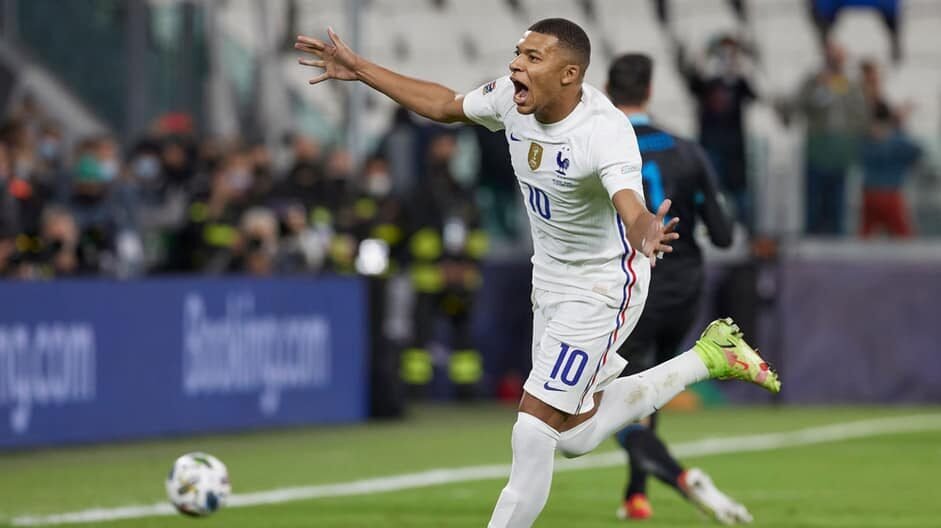
The common reading of Mbappé is that he is fast, therefore dangerous. The correct reading is the inverse: he is dangerous, and speed is one of several mechanisms he deploys to create the danger. At Real Madrid in 2025–26, operating primarily as a left-forward or inverted central striker alongside Vinícius Júnior, Mbappé’s speed functions as a threat — one that forces defensive lines to sit deeper regardless of whether he ever sprints behind them.
The data is instructive. His xG/shot ratio stands at 0.20 — meaning every shot he takes carries a 20% probability of being a goal, before he has even struck it. This is not a pace metric. It reflects shot location, approach angle, and the quality of the positions he creates. He does not rely on volume. He creates high-value opportunities, then converts them at an above-expected rate.
The xG overperformance: what the numbers actually prove
In La Liga 2025–26, Mbappé’s total xG sits at 15.2 against 17.3 actual goals — a +2.1 overperformance that is consistent across three consecutive seasons. In the Champions League this campaign, the gap is even more pronounced: 9.19 xG, 13 actual goals. He is currently the UCL’s top scorer, 3 goals clear of the next player, having scored across 9 appearances.
What the overperformance tells you is that Mbappé consistently converts chances that a statistically average elite striker would miss. The xG model assigns probability based on historical data from thousands of shots taken from similar positions. Mbappé’s sustained outperformance of that model is the cleanest evidence that his finishing technique is exceptional — not lucky.
SNIPER INTELLIGENCE
13 UCL GOALS from 9.19 xG.
This delta confirms elite ball-striking, bypassing standard probability models.
The left foot: the myth and the correction
The persistent narrative that Mbappé is one-footed has been statistically dismantled. His left-foot goals account for approximately 28% of his total career output, a proportion that has increased at Real Madrid as he has settled into a more central role. The right foot remains dominant — particularly for his preferred inside-cut finish — but the left has become a genuine threat, as detailed in our full left-foot breakdown.
The more relevant point is that the threat of the left foot expands the angular options available on any given approach, which changes how defenders position themselves — which in turn creates more space for his dominant right. The two feet are not independent; they are part of the same spatial equation.
The tactical weakness: the offside trap
Mbappé’s one documented structural weakness is his offside rate. His impatience to break the defensive line — combined with the pace that makes his runs so dangerous — means he regularly anticipates the ball by half a second too early. In the 2024–25 La Liga season, he was flagged offside more frequently than any other forward in the competition. Opposition managers who deploy a disciplined high line with coordinated stepping have consistently found it the most effective means of limiting his impact without fouling.
It is the paradox built into his game: the same acceleration that generates goals generates offsides. At 27, he has reduced — but not eliminated — the rate. It remains the primary tactical adjustment that opposing coaches make specifically for him.
The complete profile: what separates him from the comparison set
The conventional comparison set for Mbappé — Haaland, Vinicius, Salah — each represent a more specialised profile. Haaland is a pure penalty-box finisher. Vinicius is a wide creator. Salah is a consistent volume scorer. Mbappé does not slot neatly into any of those categories. His goal contribution per 90 minutes in 2025–26 (1.44 in the UCL alone), combined with his pressing contribution and his ability to create for teammates, makes the full profile genuinely rare.
The commercial dimension of that profile is worth noting. His playing style — high-visibility, high-frequency, televised sprint-to-finish sequences — generates a brand value that pure centre-forwards rarely achieve. The goals are not just goals. They are content. For a full analysis of how on-pitch performance translates to commercial value, see our 2025 earnings breakdown and our xG efficiency analysis.
— Victor Blanc | Mbappé Live
Deepen Your Intelligence
- The Data Proof: Why Mbappé is the World’s Most Efficient Finisher
- Mbappé vs Vinicius vs Haaland: The 2026 Data Benchmark
- Mbappé at the 2026 World Cup: The Complete Guide

About the author
Victor Blanc
Football Business Correspondent at Mbappé Live. Covers contracts, sponsorships, investment strategy, and the financial architecture behind elite sport.