Mbappe Diet Strategy: The Conflict Between Personal Cravings and a Billion-Dollar Brand
In the world of professional sports, an elite athlete’s body is more than just a physical vessel—it is a high-performance engine, a primary capital asset, and, in the case of Kylian Mbappé, a global marketing monument. For the Real Madrid forward and French national captain, maintaining a physique capable of explosive 38 km/h sprints requires a level of discipline that borders on the ascetic. To the public eye, Mbappé is a temple of health. Yet, beneath the polished surface of the “Galactico” lies a deeply relatable and often conflicting relationship with junk food. It is a tension between the natural desires of a young man from Bondy and the ruthless requirements of a billion-dollar brand. Discover Mbappe Diet Strategy.
The Public Standoff: Junk Food as a Strategic Enemy
The most visible manifestation of Mbappé’s “war” on junk food occurred in 2022, during a high-stakes standoff with the French Football Federation (FFF). While gathered at the elite INF Clairefontaine academy, Mbappé shocked the football world by refusing to leave his room for a scheduled commercial photo shoot. The targets of his boycott were specific and revealing: sports betting firms and, most notably, fast-food giants like KFC.
This was not a hollow gesture or a negotiation tactic for more money. Mbappé famously donates 100% of his national team earnings to charities such as Premiers de Cordée. Instead, this was a calculated move to protect the integrity of his brand. Mbappé understands that his influence over children is absolute. By refusing to associate his face with greasy buckets of fried chicken or sugary sodas, he drew a moral line in the sand. He refused to be the gateway through which unhealthy habits reached his millions of young fans. This public rejection of junk food helped him secure a partnership with Good Gout, an organic, healthy food brand for children, effectively pivoting his image from “influencer” to “role model.”
The “Cupboard Audit”: Professionalizing the Asset
However, the “temple” of Mbappé was not built on a natural distaste for burgers and fries. On the contrary, the professionalization of Mbappe diet strategy was a forced intervention led by his mother and business architect, Fayza Lamari.
In 2016, as Kylian began his stratospheric rise at AS Monaco, the family recognized that a “typical teenager’s diet” would eventually become a ceiling on his performance. Fayza hired Yaëlle, a private chef (who has since evolved into his indispensable personal assistant), with a brutal mandate: “Open the cupboards, tell me what’s wrong.”
What Yaëlle found was the reality of a boy raised in the Parisian suburbs: shelves stocked with processed cakes, sugary snacks, and the industrial junk food that defines a modern adolescence. The intervention was swift and clinical. Yaëlle purged the house, throwing the junk food in the trash to reset Mbappé’s metabolic baseline. This moment marked the transition of Kylian from a talented boy who played football to a professional asset whose fuel was as carefully managed as his contracts.
The Merguez Memory: Junk Food as Nostalgia
Despite the professional purge, junk food remains an emotional anchor for the Mbappé clan. To understand the conflict, one must understand the “Merguez Ethos.” Fayza Lamari often reminisces about the early days of the “Mbappé Project” in the 93 district, long before the private jets and Michelin-starred nutritionists.
In the world of suburban youth tournaments, football is inseparable from the smell of the sideline grill. “You play to have fun and eat your merguez with mayonnaise between matches,” she famously noted. For the Mbappé family, these greasy, spicy sausages served in crusty bread represent the joy of the game before it became a business. This creates a fascinating psychological split: while the professional athlete must reject the merguez, the human being views it as the taste of his roots.
Earned Indulgence: The “Nugget” Strategy
Today, Mbappé’s diet is a masterclass in balance, managed by Yaëlle with the precision of a laboratory. His daily fuel is famously easy-going—he is “not annoying” to feed and loves simple, high-carb recovery meals like pasta carbonara. But even the world’s most disciplined athlete cannot sustain a 60-match season on kale and steamed fish alone.
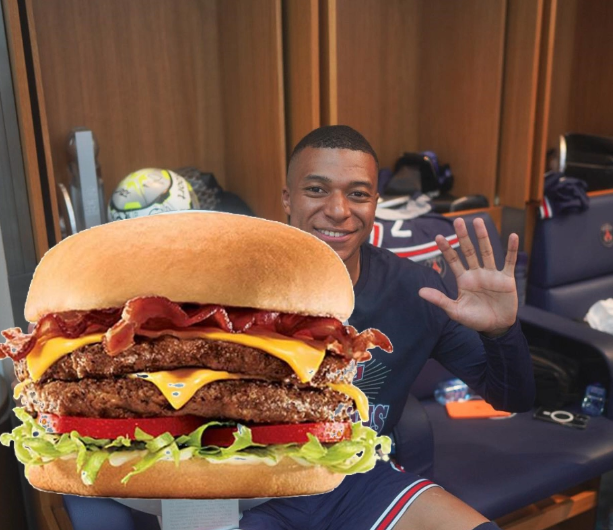
Mbappé has developed a system of “Earned Indulgence.” He has learned to listen to the physiological and psychological demands of his body. While he remains strict in the 48 hours leading up to a match, the day after a grueling Champions League night or a high-pressure La Liga game, the wall comes down. As Yaëlle reveals, he will declare with a sense of relief: “Here, I can let go… nuggets.”
This isn’t a failure of will; it is a calculated release valve. The chicken nugget serves as a psychological reward, a brief return to the “normalcy” of his youth after performing as a superhero under the global spotlight.
Conclusion: The Two Kylians
Kylian Mbappé’s relationship with junk food is ultimately a microcosm of his entire life. It is a story of two different people occupying the same skin.
There is Kylian the Man, who grew up in the concrete playgrounds of Bondy, who appreciates the simplicity of a burger, the nostalgia of a merguez, and the post-match comfort of a plate of nuggets. Then there is Mbappé the Brand, a billion-dollar entity that understands that its marketability depends on being a symbol of peak human excellence.
The conflict is resolved through a rigid separation of spheres. He may indulge in private, but he will never sell that indulgence to the public. He protects the “Empire” by publicly warring against the very foods he occasionally enjoys in the shadows. It is a ruthless, rational, and highly successful strategy that ensures that while his stomach may occasionally crave the suburbs, his brand remains firmly in the elite stratosphere of the global elite.